
Why Write?
Why not?

Why pick up the pen? Do you have something to say? Or is it simply the urge to create with words?
That urge is usually a more insistent reason, more than a “message," since writers search for things to write about. We don’t always know what we want to say. We start with a line, an image, a character or a place, a vague idea, a fragment of a story, not a subject. We use prompts, ideas or starts suggested by others.
Fiction writers often begin here, but essayists do as well since an essay is a way to explore. We write to see what we think, believe, feel, what the world looks like to us, what the creative impulse reveals. What is possible, what is likely.
Few do it for fame or money after a few rounds with publishers and the absent reviewers.
Writers say curious things about this. Lydia Davis, in a talk at Yale said she writes “because something…bothers me until I ‘do something’ about it.” Casey, Lily King’s authorial character, says “I don’t write because I think I have something to say. I write because if I don’t, everything feels even worse” (Writers and Lovers).
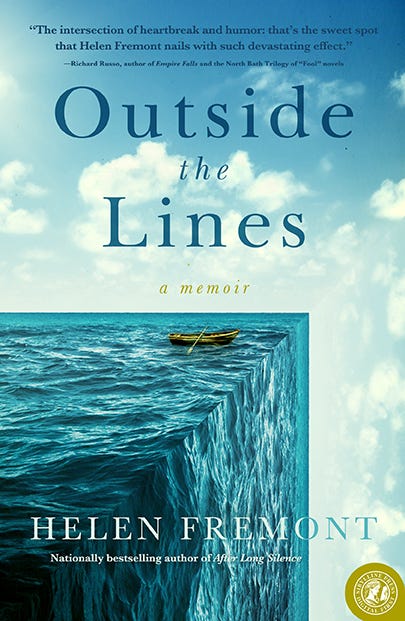
Helen Fremont’s new memoir Outside the Lines is part coming out story, part relationship story, part writerly questioning. She and her lover are both writers—two women preoccupied with literature. Together they consider the doubtful possibility of writing “truth” at all. A few snippets:
Can language ever capture the precise quality of experienced reality, given the inevitable distortions of memory? And what about the betrayals of unconscious biases, the imprecision of words themselves, the idiosyncrasies of syntax, even grammar?
…so we can agree it’s impossible to write the truth about anything.
I think fiction is more true than reality.
…everything is true, in some way or another. When you write a story, the truth of who you are is revealed on the page, no matter how you try to hide it.
Writing steers them through trauma—medical trauma, family trauma.
This seems so right to me. The focus on writing has lifted me above the dire state of the world, has sustained me through injury and loss, and reminds me there is so much to care about as we endure our current disaster. Not to escape it, because we can’t, but to survive it.
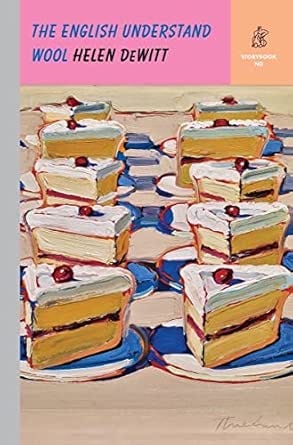
On the other hand, concerning trauma: a different Helen (DeWitt) has written a take-down of authors and publishers who create what she doesn’t call, but is elsewhere called, trauma porn. The English Understand Wool is a droll, unsettling satire, the story of con artists with exquisite taste and only contempt for those of “mauvais ton” (bad taste or poor form). When their crimes are exposed by the police, they disappear, leaving behind a teenage girl they raised and educated, a girl they abducted from relatives after she was orphaned and claimed her fortune.
Marguerite, beautifully educated now, is wooed by the publishing industry and signs a contract to tell her story for a $2.2 million advance.
The book she writes is not what they bargained for, not a victim story, but an admiring account of her imposter parents’ taste for high culture and fine things, for all they taught her. Pressed to write the book her agent and publisher want—pages saturated with the pain of being an abused and betrayed child—she outwits them with her own tale.
They threaten to sue her for the advance if she doesn’t produce an emotionally-wrenching book. Her agent first tries to persuade me: If you don’t talk about your feelings there is nothing to engage the reader and keep them turning the pages. (Standard writerly advice.) Exasperated by Marguerite, she says…at some point you’re going to have to talk about the day you learned you’d been living a lie, and what they’d done to you.
I think it is best for me to write what I know, Marguerite replies, mouthing another standard bit of advice.
They want pain, suffering, emotional appeal, something that will make her book sell wildly. She is repelled. So perhaps there were people who would like to hear about feelings but I did not think they were people I would want to know. She reflects that while a movie contract may dictate exactly how much breast an actress will expose, a publisher has no such measure. And, It was quite clear that any ‘biopic’ would inevitably be in mauvais ton.
Aided by a lawyer she surreptitiously alters the contract to allow her to keep the advance regardless of what she submits. When her agent realizes she’s been hoodwinked, she remarks that after all Marguerite was raised by crooks.
This book raises issues about the place of suffering or trauma in literature.
There is little great literature without suffering. What makes writing authentic, non-exploitive, necessary? Who’s to say what’s honest and what’s just a seduction into mawkishness, pandering to a voyeuristic public? What do we want from memoir and fiction?
Fremont’s book never slips into that seduction yet it compels us forward. She navigates a story through trauma, leaving you with an ache instead of an unpleasant taste on your palate.
The answer may start with that truism—write what you know—but calls for more than you think you know. As the writer shapes the work, considers its contradictions, reimagines it, finds humor, she makes discoveries. Another truism: if it holds no surprises for the writer, it will hold none for the reader.
And above all, you need to tell a good story.
Beverly Burch’s most recent book is the novel, What You Don’t Know. She also has four award-winning poetry collections and two nonfiction books. She lives in Oakland, CA. Website: www.beverlyburch.com
Purchase WHAT YOU DON’T KNOW here.
Thanks for reading. And your own thoughts?