
Silk threads
One mind to another

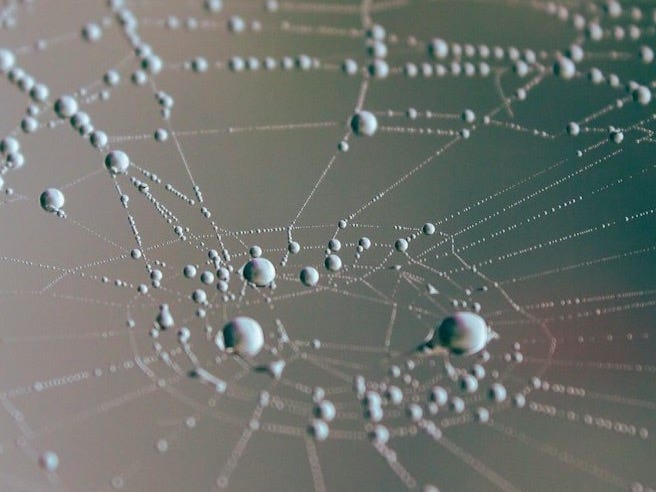
If there are threads connecting me to you, words move along these threads. Small travelers. One mind to another. They crawl through a window from the conscious to the unconscious and back, within the reader, between reader and writer, speaking from one mind to another, igniting each other. Through the largesse of literature we explore a communal mind and uncover our deep connectedness. Words possess this extraordinary power.
What about the limits though, writing we can’t enter or enjoy? What is preference or taste, the something that makes art speak to us, or fail to? Does that something lie in the structure of a reader’s (or observer’s) mind, something about how our experience and possibly our innate wiring has shaped us? Mental structure is neither rigid nor fixed, but it has its limits; otherwise the mind would have no have coherence.
Still, art opens doors, initiates something new, perhaps even, I want to say, creates new space in the mind of its reader or observer, minor renovations, a slight rearranging of the furniture. What was opaque or unappealing may suddenly become delightful. What changes is the reader, not the written.
Compare two superficially similar poems: both have short lines in one long stanza, a column of words, and both open with the moment of the speaker’s birth. They enter this moment through very different doors. Sharon Olds’ “First Hour,” from The Unswept Room:
That hour, I was most myself. I had shrugged
my mother slowly off, I lay there
taking my first breaths, as if
the air of the room was blowing me
like a bubble. All I had to do
was go out along the line of my gaze and back,
out and back, on gravity’s silk, the
pressure of the air a caress, smelling on my
self her creamy blood. The air
was softly touching my skin and tongue,
entering me and drawing forth the little
sighs I did not know as mine.
I was not afraid. I lay in the quiet
and looked, and did the wordless thought,
my mind was getting its oxygen
direct, the rich mix by mouth.
I hated no one. I gazed and gazed,
and everything was interesting, I was
free, not yet in love, I did not
belong to anyone, I had drunk
no milk, yet—no one had
my heart. I was not very human. I did not
know there was anyone else. I lay
like a god, for an hour, then they came for me,
and took me to my mother.
Extraordinary how vividly she grasps this moment, inhabiting the mind of a newborn so completely the reader says, yes, it must have been like that. Not very human and yet alive, alert. There’s a future life buried in the poem. She will fall in love, will hate, will not be so free any more; the foreboding last line glimpses a relationship, the mother who will make her human and no longer free. What is not said hovers through the poem. And again, there’s the spider of the mind, spinning its strands, following the gaze, out and back on gravity’s silk.
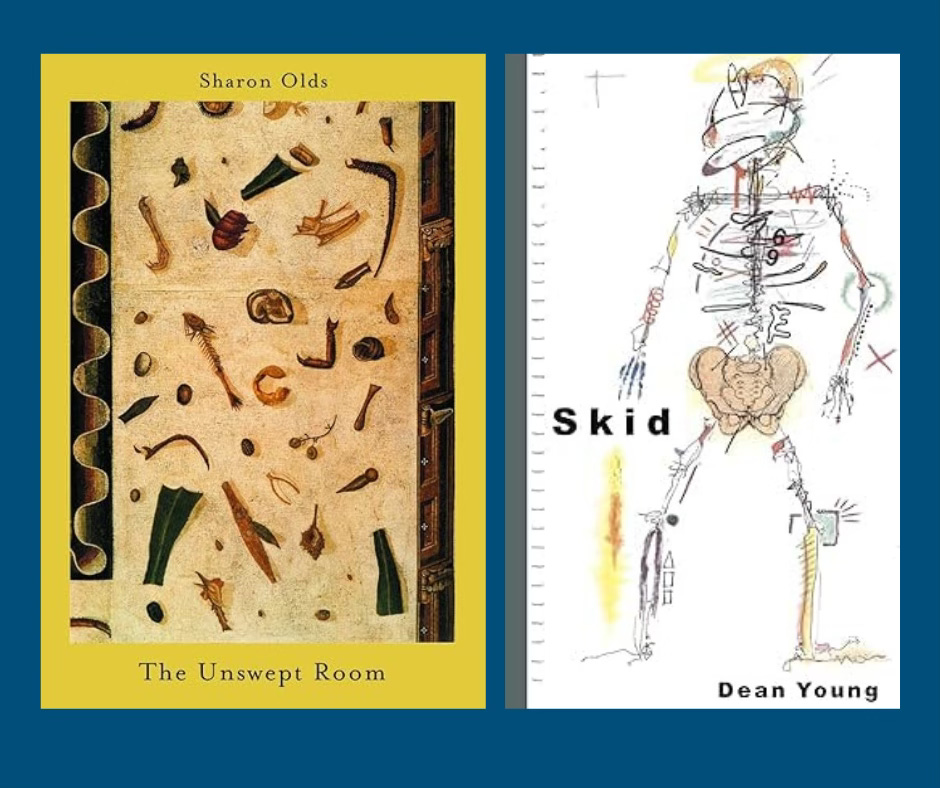
The birth moment in Dean Young’s “My People” from Skid reads in a wildly disparate way, his arch humor mocking the notion of innocence.
Initially, I too appeared between the legs
of a woman in considerable discomfort.
A rather gristly scene but fairly common
among my kind. Those early days, I must
admit: a bit of a blur but generally
I was provided for, wiped off
and kept away from the well.
Dressed as a shepherdess until
I could handle an ax, it was then
I saw the golden arches and tasted of
the processed cheese and left my field
forever, disastrously it must be said
although it has led me here, addressing you
in this grand and ugly hall, paid
a nominal fee and all the grapes
I can eat. Well, I’m told they’re grapes.
But I leap ahead when leaping backward
as well as vibrating in place
is more what’s called for,
much like the role of the tongue
in the bell. Hear that?
Reminds me of the coyotes of our youth
before we hunted them to near extinction
then expensively reintroduced because
it turned out they were the only solution
to our rodent problem, at least
on the outside, in the cribs. Inside,
it’s a grackle/possum/viper problem too,
even algae in some areas. Somehow
we’ve managed to ruin the sky
just by going about our business,
I in my super XL, you in your Discoverer.
A grudging and fat-cheeked tribe,
we breed without season, inadvertently
or injected with quadruplets. The gods
we played with broke, they were made of glass.
The trees our fathers planted we will not see again.
No meditative moment here, no sympathy with the self (though some for the mother, entirely missing in Olds’ poem which invites sympathy only for the self). There’s the “we” as much as the “I.” No dwelling in the moment but instead speed, rapid aging, a race from the pastoral to a poisonous urbanity, steady decline and again an ominous future. Both poems indict, one gradually hitting loss, the other amassing losses rapidly.
We’re aware of dialoguing with very different minds, of having entered unexpected rooms through unmistakably different doors.
Culture and class are evident though unnamed, the stamp of each poet. Young’s speaker is well-off, part of the “fat-cheeked” tribe who destroy the earth. Olds’ infant is more ambiguous, yet the safety and peace of the first early moment assures us it is not a traumatic or endangered birth, but one in a hospital with attendants. Unnamed elements are absorbed unconsciously, taken for granted by a similarly situated reader, notable to one who isn’t, and in each case different responses are triggered.
Probably you prefer one over the other, a preference that reflects something of your own mind even if not a mirror of it. Yet you can likely find something appealing in each, something that may stretch your state of mind a bit, triggering criticism or appreciation, even both.
How can you not feel awe at the power of small black marks on paper that they can do so much? How foolish that we once said “Sticks and stone can break my bones, but words can never hurt me.” The humor and pleasure and despair encoded in both poems elicits a pang even as I love the narrow focus of one, the wide horizon of the other—that divine finesse of language.
Purchase WHAT YOU DON’T KNOW here.
Thanks for reading. And your own thoughts?

I love the contrast of the two poems. Olds’ took me right in and moved me. I enjoyed Young’s poem from a bit of a distance.
I love this visceral example of the way different words and writers affect us in such different ways. I find Old’s poem luminous with a spiritual knowing that moves me.