
Day into Night
We live in two worlds.

While there’s light outside, you’re preoccupied with living, all the things you do, those daily demands, what you want to do and what you don’t, including a lot of basic maintenance. You’re busy. Then the sky darkens, you tire, you go to bed and (you hope) fall asleep. Activity ceases as you enter another reality, the dream life.
Different rules operate there. It’s an irrational world, emotionally-driven, vivid, frightening at times, thrilling at times, cartoonish at other times or chaotic. When you return to your waking life, you probably forget that other reality—it makes no sense anyway—but dreams leave a residue, a fragment, a feeling, an image or a cracked narrative, even a yearning to return to a dream which flitted away before you could catch it.
The two different worlds are semi-porous. With a little effort you can remember a dream. Often waking life sneaks into dreaming life: the movie you saw or the people you encountered. The mystery of why we live in such different realities is there for philosophy, psychology, neuroscience and literature to explore.

Every culture has a story about the meaning of dreams. Many collect them, and some put the dreams of their community or tribe together daily to create a larger dream. They’re messages from the gods, foreshadowings of the future, the mind’s way of cleansing itself, a neurotic puzzle to be analyzed, or pure nonsense. They reflect forbidden wishes or suppressed memories.
Mysteries, but sometimes I grasp meaning from a dream and sometimes my unconscious speaks of something I need to know. I love that we dream and sometimes find that world more compelling than waking life.
A curious thing about the word dream is its two meanings. Dreams are aspirations and ambitions, ideals. Sleeping dreams are a kind of delusion. Their etymologies are different—the Proto-German word traum meant deception or delusion, even harmful, the Old English word dréam meant joy, music, making merry—but they merged. We say “be careful what you wish for,” when perhaps we should say “be careful what you dream.” Aspirations, ambitions and ideals can be delusions and harmful.
I just re-read Dorothy Bryant’s The Kin of Ata are Waiting for You, a speculative novel from 1971 that’s become a classic. Ata is a place like Atlantis, an island that sinks into invisibility for anyone who doesn’t live there. The racially diverse people consider themselves kin and dream life is the real life. Waking life is all about maintaining the self for the dream world.
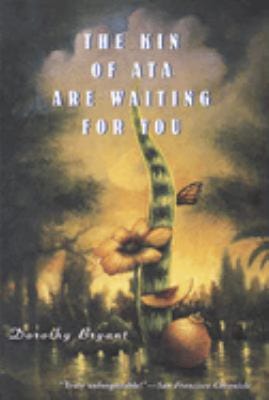
In Ata, things that affect one’s capacity to dream, like violence, hate, anger, envy, jealousy, worry, shame, i.e., negative feelings, are avoided if possible—they have a process for shedding these feelings. No one judges another’s life because it is assumed everyone is living according to what their dreams guide them to, from where to plant crops, what their name is, how to create, how they love, feed and clothe themselves: For, assuming all the people truly believed in their dreams, and lived with only one ambition, to be “strong dreamers,” the ordering of work in this little society was assured without compulsion.
Our narrator lands in this world after a serious accident and observes the people with amusement as well as wonder: They reminded me of the look I’d seen on the faces of people who carry transistor radios around and listen to them all day long—that faraway, attentive look. Their lives seem primitive, even monotonous, until he learns the subtleties of the culture, the pleasures and joys it holds.
The kin do not believe dreams themselves are reality but that in dreams reality comes clothed in coverings we can recognize and describe.
Ata’s an appealing world, where people learn how to live. They prefer songs and dances to words, which can be deceptive; they love whoever and however they wish; they don’t work too much. They look with pity and sorrow at the world we live in. This book lifts the reader out of the sorrowful world and imagines how to live otherwise, pointing to a deeper way and another reality. Ongoing maintenance—spiritual and cultural—is necessary to reach into dreams because humans are easily led astray without the way of dreams.
Jung, Freud and neuroscientists (who often dismiss dreams) shape our Western view of dreams. Jung’s view is a bit like Ata’s as there is something like a collective unconscious in their understanding and skilled dreamers can enter each other’s dreams. Freud’s view tilts toward the dark side, things we don’t want to see, but that’s there in Ata too.
My own dreams can be troubling, sometimes witty, sometimes epic—a Hollywood saga with a cast of thousands. People from the past return with an essence I cherish about them, not their actual messy selves. I feel bereft when I wake up and lose them again. I have felt love or attraction to an acquaintance I never felt attraction to in waking life. I’ve been chased, hunted, lost, I’ve known how to fly, walk across roofs, or outwit a gang of villains (usually, but not always, men). I’ve been caught out in them—the exam I didn’t study for, the theater production I didn’t know I had a role in.
I don’t have much of a theory about dreams, but I do love Bryant’s strange little book. Its thesis resonates with me intuitively, as it has with many others: we might possess something that can guide us and we need ongoing practice to stay attuned to what is larger than the daily muck and muddle of being human.
Purchase WHAT YOU DON’T KNOW here.

Thanks for reading. And your own thoughts?
This is great. I like bringing this awareness to the two worlds we live in again.
Fascinating. Some years back I joined a “dream group” at the Unitarian church which met weekly and learned about dreams. We kept dream journals by the bed, learned techniques for capturing the dream before it gets away upon waking. And how to interpret the dreams. One of the most surprising findings was that some of my dreams predicted the future!